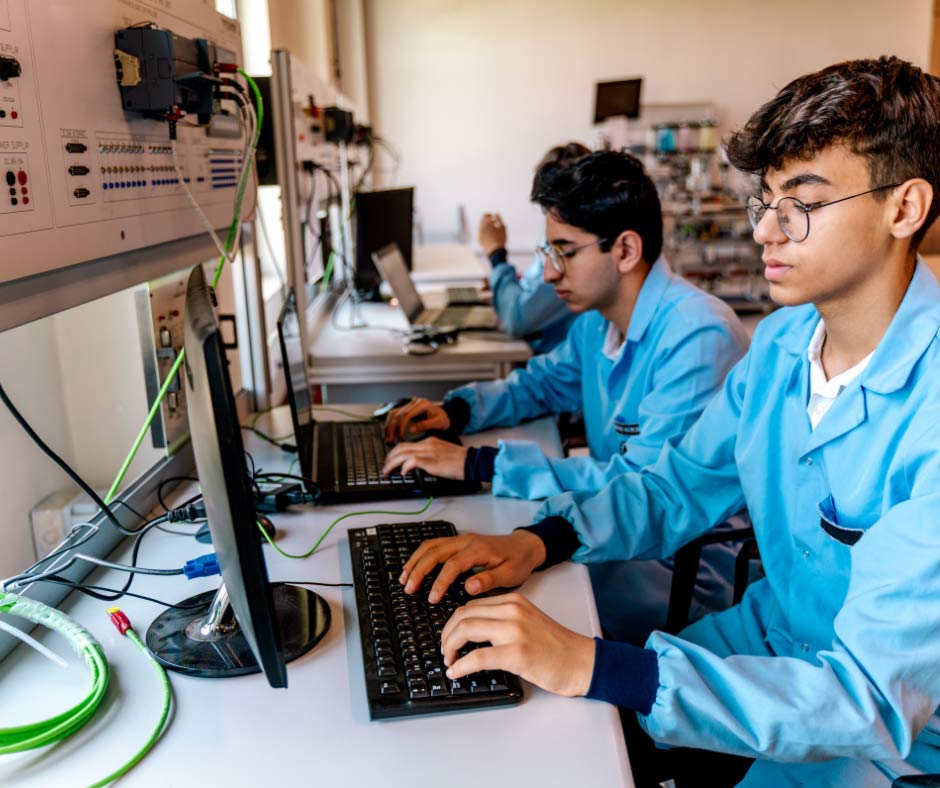

TLLF Launches Carolina Career-Connected Learning Challenge to Expand Pathways to Livable-Wage Careers
Coding a new future | Oksana’s path from community college to tech apprenticeship
December 9, 2025Finding Hope in the Middle
January 18, 2026The Leon Levine Foundation has launched the Carolina Career-Connected Learning Challenge, a multi-million-dollar RFP designed to expand career-connected learning opportunities for students in grades 7–14 across North and South Carolina. The challenge will invest up to $2.5 million in nonprofit organizations that are strengthening the connection between education and the workforce, with a focus on improving outcomes for low-income and first-generation students.

Through unrestricted, one-year grants ranging from $150,000 to $250,000, the Foundation will support proven programs that help students transition from middle and high school into postsecondary education and, ultimately, into careers that provide long-term economic stability. Select organizations demonstrating strong impact may be eligible for larger grants and/or additional follow-on funding.
The RFP responds to a persistent and troubling reality facing students in the Carolinas. Today, only 31 out of every 100 ninth-grade students in public schools will graduate, enroll in college, and earn a degree or industry-valued credential within six years. For students from low-income and first-generation backgrounds, the odds are even lower.

“We know that talent is everywhere, but opportunity is not,” Russ Altenburg, program director at The Leon Levine Foundation, said. “This challenge is about ensuring students, particularly those from low-income and first-generation backgrounds, have access to real-world learning experiences, employer-aligned pathways, and clear routes to livable-wage careers that can support families and strengthen communities across the Carolinas.”
The challenge centers on career-connected learning, an approach that integrates academic instruction with real-world work experiences, employer engagement, and industry-recognized credentials. Research shows that these experiences help students connect their interests to in-demand careers while giving employers a stronger, more prepared talent pipeline. Yet access remains uneven. Only about half of middle and high school students report learning skills relevant to the jobs they want, and fewer than one-third believe their school is preparing them for the workforce.
Rather than funding new or untested ideas, the Foundation is focused on scaling programs that already demonstrate success. Eligible applicants must currently serve students in grades 7–14 or first-generation college students from low-income communities, and operate in North or South Carolina. While organizations may be based elsewhere, funded projects must directly benefit students in the Carolinas.

Through this challenge, TLLF aims to put more students on supported pathways to careers that meet or exceed the MIT Living Wage for their county and are resilient to automation and artificial intelligence. The initiative also seeks to improve postsecondary attainment and credential completion, strengthen alignment across grades 7–14, and elevate the role of employers in co-designing education and workforce pathways.
Strong applicants will demonstrate comprehensive approaches that combine work-based learning opportunities, access to industry-recognized credentials, flexible and career-aligned academic pathways, and seamless partnerships among schools, postsecondary institutions, and employers. Successful programs will also reflect intentional engagement with families and communities, thoughtful use of technology to support career exploration, and clear strategies for job placement or postsecondary success.
The Carolina Career-Connected Learning Challenge reflects The Leon Levine Foundation’s broader commitment to helping underserved Carolinians achieve self-sufficiency by expanding access to education and economic opportunity. By investing in scalable, employer-informed models, the Foundation aims to reshape how students experience learning and how pathways to economic mobility are built across the region.
Organizations interested in applying can find full RFP details, eligibility requirements, and key dates on the Foundation’s dedicated microsite.